
 28 November 2026
What Is Travel Insurance and Why Do You Need It When Travelling Abroad?
8 November 2026
6 minutes read
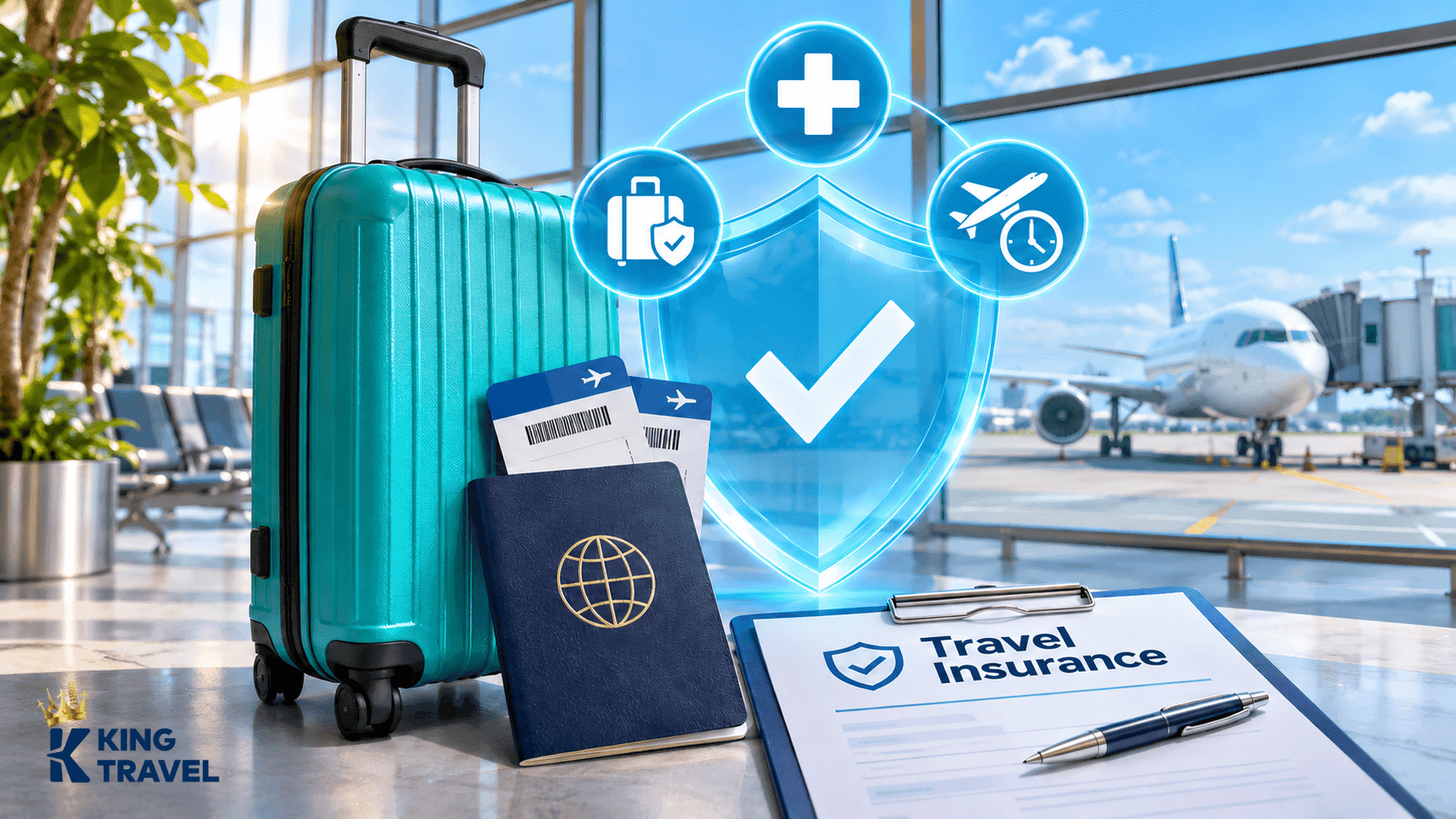
When planning a trip abroad, most of us think about flights, hotels and visas first, and travel insurance is often left until the last minute. Yet if you fall ill, get injured or lose your luggage on the way, this is the policy that pays. Some countries will not even issue a visa without it.
In this guide, the King Travel team explains what travel insurance is, what it usually covers, what the Schengen visa rules require and what to check before you buy a policy.
Short answer
Travel insurance covers unexpected costs while you are abroad, such as emergency medical care, hospital treatment and repatriation for medical reasons. Applicants for a Schengen visa must show travel medical insurance with minimum cover of EUR 30,000. For visa-free trips it is usually not mandatory, but it protects you from paying foreign medical bills yourself.
What is travel insurance?
Travel insurance is a policy bought for specific dates and a specific territory. The policy states the start and end dates of the trip, the countries where it is valid, the sum insured (the maximum the insurer will pay) and the situations it pays for.
If you fall ill or are injured abroad, you first call the insurer's 24-hour assistance line. The assistance service directs you to a suitable clinic and, depending on the terms, either pays the clinic directly or reimburses you later.
What does travel insurance cover?
Cover differs from policy to policy. The table below shows the most common benefits. Always check the exact list in your own policy terms.
| Benefit | What it covers | Where you find it |
|---|---|---|
| Emergency medical care | Doctor visits, emergency care, medicines | Almost every medical policy |
| Hospital treatment | Emergency admission and treatment | Medical policies |
| Medical repatriation | Transport home or to a suitable place for treatment | Medical policies; required for Schengen |
| Repatriation in case of death | Cost of returning the deceased home | Schengen-compliant policies |
| Baggage | Lost, damaged or delayed luggage | Optional add-on |
| Trip cancellation | Non-refundable costs if you cancel for a valid reason | Optional add-on |
| Flight delay | Expenses caused by a long delay | Optional add-on |
What is usually not covered?
Always read the exclusions before you buy. Many policies do not pay, or pay only for an extra premium, in these cases:
- pre-existing or chronic conditions;
- injuries from active or extreme sports such as skiing or diving;
- incidents under the influence of alcohol;
- treatment arranged on your own without contacting the assistance service;
- planned treatment and cosmetic procedures.
Why do you need travel insurance?
Medical care abroad is usually paid for visitors, and a few days in hospital can cost more than the whole trip. Insurance takes on that risk. A policy can also be a required document for a visa application.
- For the visa. Schengen countries do not accept a visa application without travel medical insurance.
- For your health. In an emergency, the assistance service tells you where to go, and the insurer pays.
- For peace of mind. Baggage, flight and cancellation cover protect you from other unexpected losses.
Insurance is useful on visa-free trips too. See the list of visa-free countries for Azerbaijani citizens, and for winter ideas read where to go in winter without a visa.
Travel insurance for a Schengen visa: the requirements
Under the EU Visa Code (Regulation (EC) No 810/2009, Article 15), Schengen visa applicants must prove they hold travel medical insurance. The policy must:
- provide minimum cover of EUR 30,000;
- be valid throughout the territory of the Schengen states;
- cover the entire period of the intended stay;
- cover urgent medical attention, emergency hospital treatment, repatriation for medical reasons and repatriation in case of death.
As a rule, the insurance is taken out in your country of residence. For a multiple-entry visa, the policy must cover the first intended visit, and you sign a statement in the application form confirming that you know insurance is needed for later trips.
For the full list of documents, read Schengen visa documents for Azerbaijani citizens. If you need help with the application, our visa service supports you with document preparation, including guidance on insurance requirements.
Other countries have their own rules, and they change from time to time, so check entry requirements for each destination. For an example from Asia, see our guide to the Thailand visa for Azerbaijani citizens.
How to choose travel insurance
Look beyond the price and check these points:
- Sum insured. Schengen requires at least EUR 30,000. For other destinations, consider how expensive medical care is in the country you visit.
- Territory. The policy must be valid in every country on your route, including transit countries.
- Dates. It must cover the whole trip, from the day you leave to the day you return.
- Deductible. This is the part of each claim you pay yourself. Policies without a deductible usually cost a little more.
- Activities. If you plan to ski or dive, make sure these activities are included.
- Assistance. Check that there is a 24-hour line and support in a language you speak.
- Exclusions. Read what is not covered before you buy.
What affects the price of travel insurance?
Prices are not fixed and differ between insurers. The main factors are:
- trip length: the more days, the higher the price;
- territory: regions with expensive medical care cost more to insure;
- the sum insured and whether there is a deductible;
- the traveller's age;
- add-ons such as baggage, cancellation or sports cover.
The insurer you buy from calculates the exact price for your dates and destination.
What to do if something happens abroad
- Call the assistance number on your policy as soon as possible and give your policy number.
- Go to the clinic the assistance service recommends. If you choose another clinic yourself, the costs may not be covered.
- Keep all medical documents, receipts and doctors' reports.
- For theft or loss, get an official report from the local police or the airline.
- After you return, submit the documents to the insurer within the period stated in the policy.
Travel insurance in King Travel tours
Many King Travel tour packages include travel insurance. For example, the Valentine's Day Istanbul tour, Maldives tour and Bali tour include travel insurance in the price. You can see what each package includes in the «Inclusions» section of the tour page. Browse all destinations on our tours page.
Frequently asked questions
Is travel insurance mandatory?
It is mandatory when you apply for a Schengen visa. For visa-free trips it is usually not required, but it is recommended because it removes the risk of paying medical costs abroad.
How much cover do I need for a Schengen visa?
The minimum is EUR 30,000. The policy must be valid in all Schengen states and cover the whole stay.
What does travel insurance cover?
A basic medical policy covers emergency medical care, hospital treatment and medical repatriation. Baggage, trip cancellation and flight delay are usually offered as add-ons.
When should I buy travel insurance?
For a visa, the policy is submitted with the application, so buy it before you apply. If you want cancellation cover, buy it right after booking your flights and hotel.
Are chronic conditions covered?
Many policies exclude pre-existing conditions or cover them only on extra terms. Check this with the insurer before you buy.
Do I need separate insurance if I buy a tour package?
If the package includes travel insurance, you do not need a separate policy. Check the tour's «Inclusions» section, and if you plan active sports, make sure the cover is enough.
If you want to plan a trip, pick a tour with insurance included or prepare documents for a visa application, contact King Travel. Our team will suggest the most convenient option for your trip.
Last checked: 8 November 2026.